Issue #1069
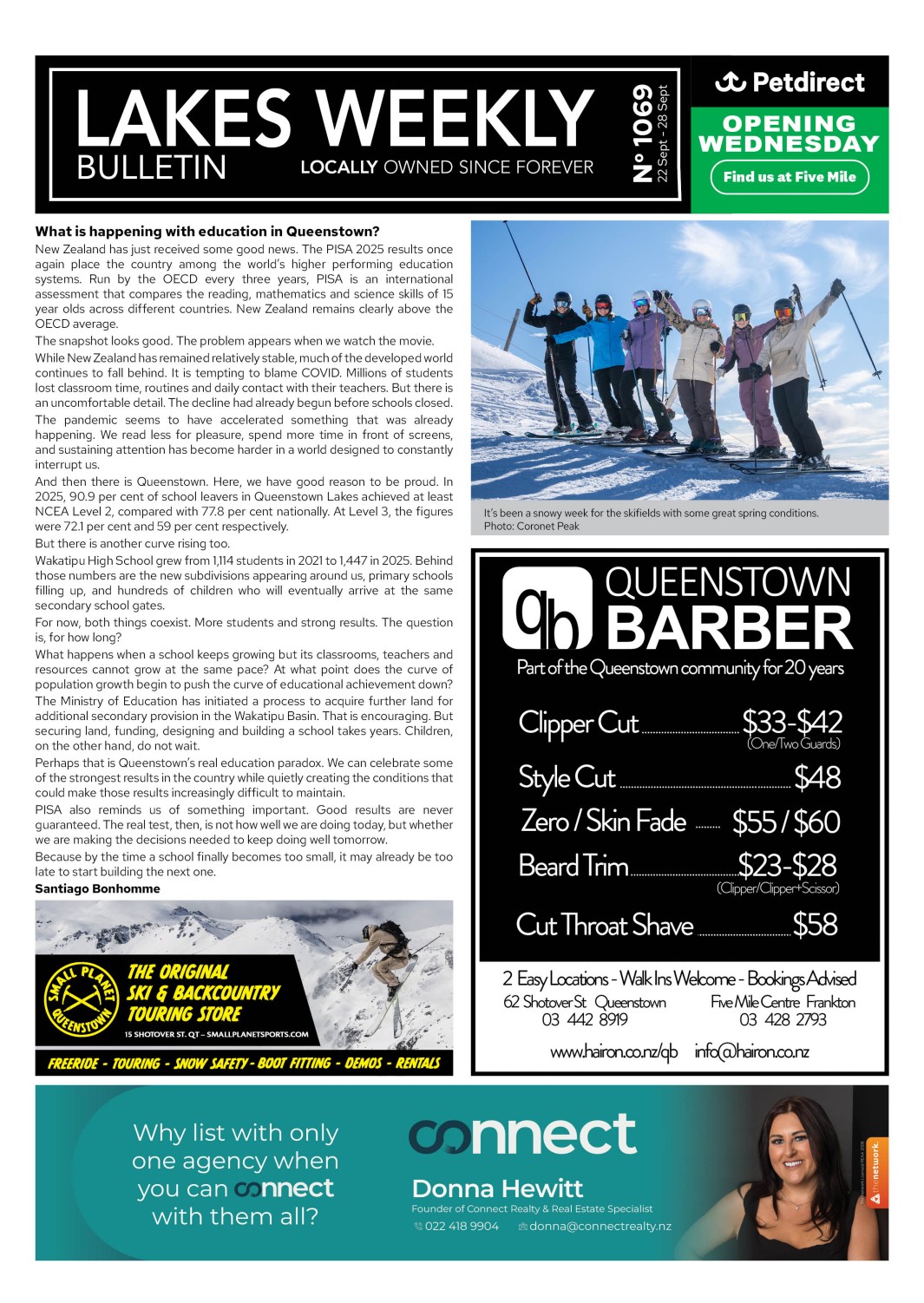
What is happening with education in Queenstown?
by Santiago Bonhomme
New Zealand has just received some good news. The PISA 2025 results once again place the country among the world’s higher performing education systems. Run by the OECD every three years, PISA is an international assessment that compares the reading, mathematics and science skills of 15 year olds across different countries. New Zealand remains clearly above the OECD average.
The snapshot looks good. The problem appears when we watch the movie.
While New Zealand has remained relatively stable, much of the developed world continues to fall behind. It is tempting to blame COVID. Millions of students lost classroom time, routines and daily contact with their teachers. But there is an uncomfortable detail. The decline had already begun before schools closed.
The pandemic seems to have accelerated something that was already happening. We read less for pleasure, spend more time in front of screens, and sustaining attention has become harder in a world designed to constantly interrupt us.
And then there is Queenstown.
Here, we have good reason to be proud. In 2025, 90.9 per cent of school leavers in Queenstown Lakes achieved at least NCEA Level 2, compared with 77.8 per cent nationally. At Level 3, the figures were 72.1 per cent and 59 per cent respectively.
But there is another curve rising too.
Wakatipu High School grew from 1,114 students in 2021 to 1,447 in 2025. Behind those numbers are the new subdivisions appearing around us, primary schools filling up, and hundreds of children who will eventually arrive at the same secondary school gates.
For now, both things coexist. More students and strong results.
The question is, for how long?
What happens when a school keeps growing but its classrooms, teachers and resources cannot grow at the same pace? At what point does the curve of population growth begin to push the curve of educational achievement down?
The Ministry of Education has initiated a process to acquire further land for additional secondary provision in the Wakatipu Basin. That is encouraging. But securing land, funding, designing and building a school takes years. Children, on the other hand, do not wait.
Perhaps that is Queenstown’s real education paradox. We can celebrate some of the strongest results in the country while quietly creating the conditions that could make those results increasingly difficult to maintain.
PISA also reminds us of something important. Good results are never guaranteed.
The real test, then, is not how well we are doing today, but whether we are making the decisions needed to keep doing well tomorrow.
Because by the time a school finally becomes too small, it may already be too late to start building the next one.


WHY ADVERTISE YOUR BUSINESS WITH US
The Lakes Weekly is part of Queenstown Media Group (QMG).
QMG is Queenstown’s leading locally owned and operated media company with print, online and social platforms that engage locals with what they care about — everything local!
The Lakes Weekly delivers stories and news that connects with local so they come away each week better connected to their community. Advertising sits within this curated content environment, and it’s a trusted relationship between readers and the Lakes Weekly. Advertisers benefit from the association with the LWB brand values.
The Lakes Weekly is hand delivered to every business in Queenstown, Arrowtown, Frankton, Five Mile Remarkables Park and Glenda Drive on Tuesday. Copies are available in service stations, libraries and drop boxes throughout the region and every supermarket throughout the Queenstown basin and Wanaka.
Online the issue is available Monday afternoon, on lwb.co.nz and the Qtn App.
3,500
Printed copies
each week
13,250
Estimated weekly
readership
Latest issue