Mary May - Mary knows these mountains

It takes a bit to faze Mary May. The hardy 89-year-old, once a Scurr, was raised deep in the Cardrona Valley, no electricity until after she’d left home to work in Wanaka in 1956.
Her farming rabbiter dad, Jack Scurr, worked hard to support the family, eventually building a verandah onto their farm cottage near Wanaka, Mary and her younger sister sleeping on the verandah through icy winters, just a hot water bottle for comfort.
“Dad rabbited hard to buy 13,000-acre Spott’s Creek Station, which was subdivided off Wanaka Station in 1939 when I was two,” she says. “We’d help him cut and spread the carrots,” Mary says.
She was delivered in the original Ballarat Street Maternity Home by the legendary Dr Anderson, a calico tent attached to a stone hut in the Cardrona Valley accommodating new Scurr arrivals.
It was a mile walk or bike ride to catch the bus to the two-room Wanaka School where the kids toasted their sandwiches on the pot belly stove.
There was no keeping the Scurr kids fenced in: “Mum was waiting in Arrowtown to have my brother Kevin, my sister and I staying at home with a lady from the valley. We made our way off on the flats with our dolls to go find Mum, this poor woman frantically trying to find us.”
Sister Noeline was unimpressed when Mary’s bike wheel got caught in the gap between two planks of poplar Dad had placed over the creek to bike across to the bus, sending Noeline flying off into the water. “My bike got stuck in the crack. I’d been told to walk her across,” Mary grins.
Mary only had one year at St Dominic’s boarding school in Dunedin, a year of good wool sales in 1951.
At 15 she had to leave and come home to help her mum, biking several times a year into Wanaka. “If our uncle was going on a date he’d take us girls into Wanaka to the ‘pictures’ while he entertained his date across the road at the pub.” The ‘pictures’ at Wanaka Hall were a social highlight, along with dances in Luggate, Hawea and Wanaka. “If I was lucky my other uncle, who played in a band, took me with him.”
After three years on the station, Mary worked at the Wanaka Post and Telegraph Exchange, a town of 300 to 400 then. A trip to Wellington for six months toll exchange training, so many new towns and place names, was a huge adventure, back by the early 50s receiving telegrams in Wanaka. At 18 she’d often be alone on shift until midnight, biking around the gravel roads at Beacon Point and out towards Wanaka Station to deliver telegrams by day.
“I remember the secondary school people highly excited waiting for the telegrams with their exam results,” she says.
One day a “smiley” Hawea musterer, Alan May, came in to ring his girlfriend in Cromwell. “He’d been told about the Scurr girls,” Mary grins. “He had to come around to pay his toll fee and we got chatting through the hole in the door.”
They married in 1957, ‘married couple’ at Lake Hawea Station for four years, two babies by then before moving to Hillend Station in Cardrona to work for Mary’s dad. After Mary’s parents retired they moved to Spott’s Creek.
The rivers froze over during the Big Snow of 1968, helicopter pioneer Sir Tim Wallis brought in to fly hay bales to the sheep. “We were definitely cut off that winter. Most of the winter everything was frozen and there was snow around us.” Mary had five little girls and a son on the way.
“I was brought up in that. It didn’t faze me.” She’d learned the tricks from her parents, "hang the ceramic dog on a string onto the toilet flusher and the water won’t freeze”.
Besides, kerosene had kept the fridge running and lamps going when she was a kid.
After eight years farming in the Cardrona Valley, Alan and Mary bought Wentworth Station at Gibbston in 1969, their youngest Noel just one. “That was a new experience, but a good family friend Topsy Anderson helped me greatly.” Mary wrapped herself around the one-teacher Gibbston School and became involved with the Arrowtown Playschool, while youngest daughter Robyn attended.
They farmed a 20,000-acre station, including Peregrine Woolshed and flats below Nevis Bluff, a hot windy climate, irrigation a priority. Mary raised six kids, cooking for shearers, musterers and farmhands, and providing endless tea for visiting stock agents. “There was always something in my tins,” she smiles.
She tried contract caterers but gave them a miss: “They wasted so much food.”
Mary had grown up through the World War II years in a family that was largely self-sufficient – mutton, milk from the cow churned into butter, eggs and hens.
“We were on a party line, and I remember when the phone call came through and Dad sat us all down when we got home from school to announce we had running water. He was so proud.”
“I remember these bachelors on our party line at Mount Barker who’d offer a few expletives to a lady spinster who had hens as they could hear the hens down the phone so knew she was listening in to their calls,” Mary chuckles.
They were 25 years at Wentworth, farming at times a balancing act. Alan was president of the Lake Hayes Show not long after the government removed SMPs (Supplementary Minimum Prices) for farmers in the early 80s.
In the late 1970s Mary joined the Arrowtown Golf Club, Gibbston School had closed, the kids at Queenstown District High. She became the club’s first woman president, a Life Member since the early 1990s, also president of Otago Women’s Golf. For 20 years she’s cooked and delivered kindness meals to cancer patients as a Cancer Society volunteer.
Renowned for her delicious sponge drops, Mary’s volunteer baking’s been raising funds for decades too. “I started making those for the shearers in the 1970s.”

Proud Grandma Mary, at rear, with the grandkids in the late 1990s. Absent, baby Kendra just weeks old
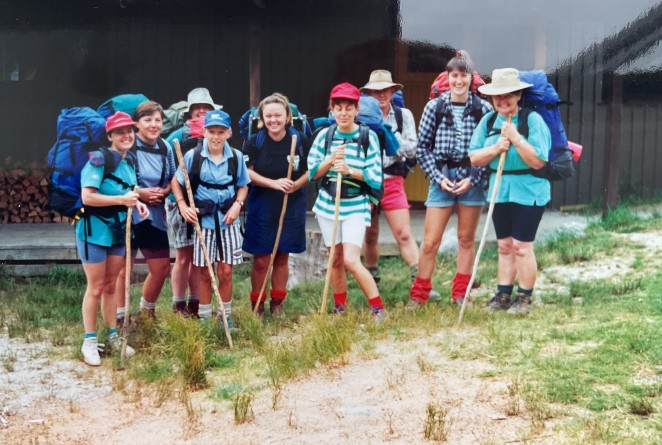
Far right, Mary and family heading off on the Milford Track in the mid-1990s