Latest issue
#1077
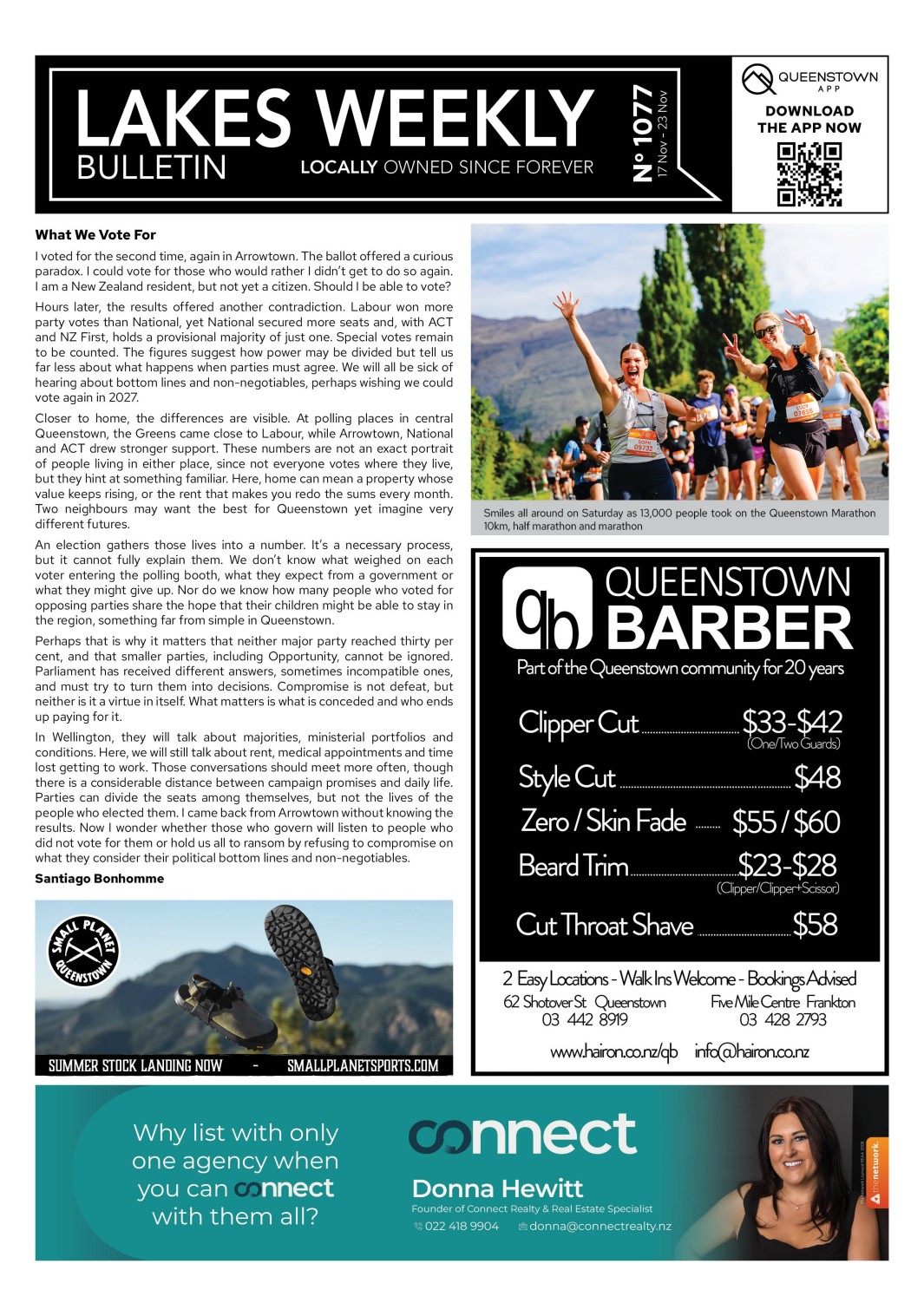
What We Vote For
by Santiago Bonhomme
I voted for the second time, again in Arrowtown. The ballot offered a curious paradox. I could vote for those who would rather I didn’t get to do so again. I am a New Zealand resident, but not yet a citizen. Should I be able to vote?
Hours later, the results offered another contradiction. Labour won more party votes than National, yet National secured more seats and, with ACT and NZ First, holds a provisional majority of just one. Special votes remain to be counted. The figures suggest how power may be divided but tell us far less about what happens when parties must agree. We will all be sick of hearing about bottom lines and non-negotiables, perhaps wishing we could vote again in 2027.
Closer to home, the differences are visible. At polling places in central Queenstown, the Greens came close to Labour, while Arrowtown, National and ACT drew stronger support. These numbers are not an exact portrait of people living in either place, since not everyone votes where they live, but they hint at something familiar. Here, home can mean a property whose value keeps rising, or the rent that makes you redo the sums every month. Two neighbours may want the best for Queenstown yet imagine very different futures.
An election gathers those lives into a number. It’s a necessary process, but it cannot fully explain them. We don’t know what weighed on each voter entering the polling booth, what they expect from a government or what they might give up. Nor do we know how many people who voted for opposing parties share the hope that their children might be able to stay in the region, something far from simple in Queenstown.
Perhaps that is why it matters that neither major party reached thirty per cent, and that smaller parties, including Opportunity, cannot be ignored. Parliament has received different answers, sometimes incompatible ones, and must try to turn them into decisions. Compromise is not defeat, but neither is it a virtue in itself. What matters is what is conceded and who ends up paying for it.
In Wellington, they will talk about majorities, ministerial portfolios and conditions. Here, we will still talk about rent, medical appointments and time lost getting to work. Those conversations should meet more often, though there is a considerable distance between campaign promises and daily life. Parties can divide the seats among themselves, but not the lives of the people who elected them. I came back from Arrowtown without knowing the results. Now I wonder whether those who govern will listen to people who did not vote for them or hold us all to ransom by refusing to compromise on what they consider their political bottom lines and non-negotiables.

WHY ADVERTISE YOUR BUSINESS WITH US
The Lakes Weekly is part of Queenstown Media Group (QMG).
QMG is Queenstown’s leading locally owned and operated media company with print, online and social platforms that engage locals with what they care about — everything local!
The Lakes Weekly delivers stories and news that connects with local so they come away each week better connected to their community. Advertising sits within this curated content environment, and it’s a trusted relationship between readers and the Lakes Weekly. Advertisers benefit from the association with the LWB brand values.
The Lakes Weekly is hand delivered to every business in Queenstown, Arrowtown, Frankton, Five Mile Remarkables Park and Glenda Drive on Tuesday. Copies are available in service stations, libraries and drop boxes throughout the region and every supermarket throughout the Queenstown basin and Wanaka.
Online the issue is available Monday afternoon, on lwb.co.nz and the Qtn App.
3,500
Printed copies
each week
13,250
Estimated weekly
readership
Latest issue