Latest issue
#1063
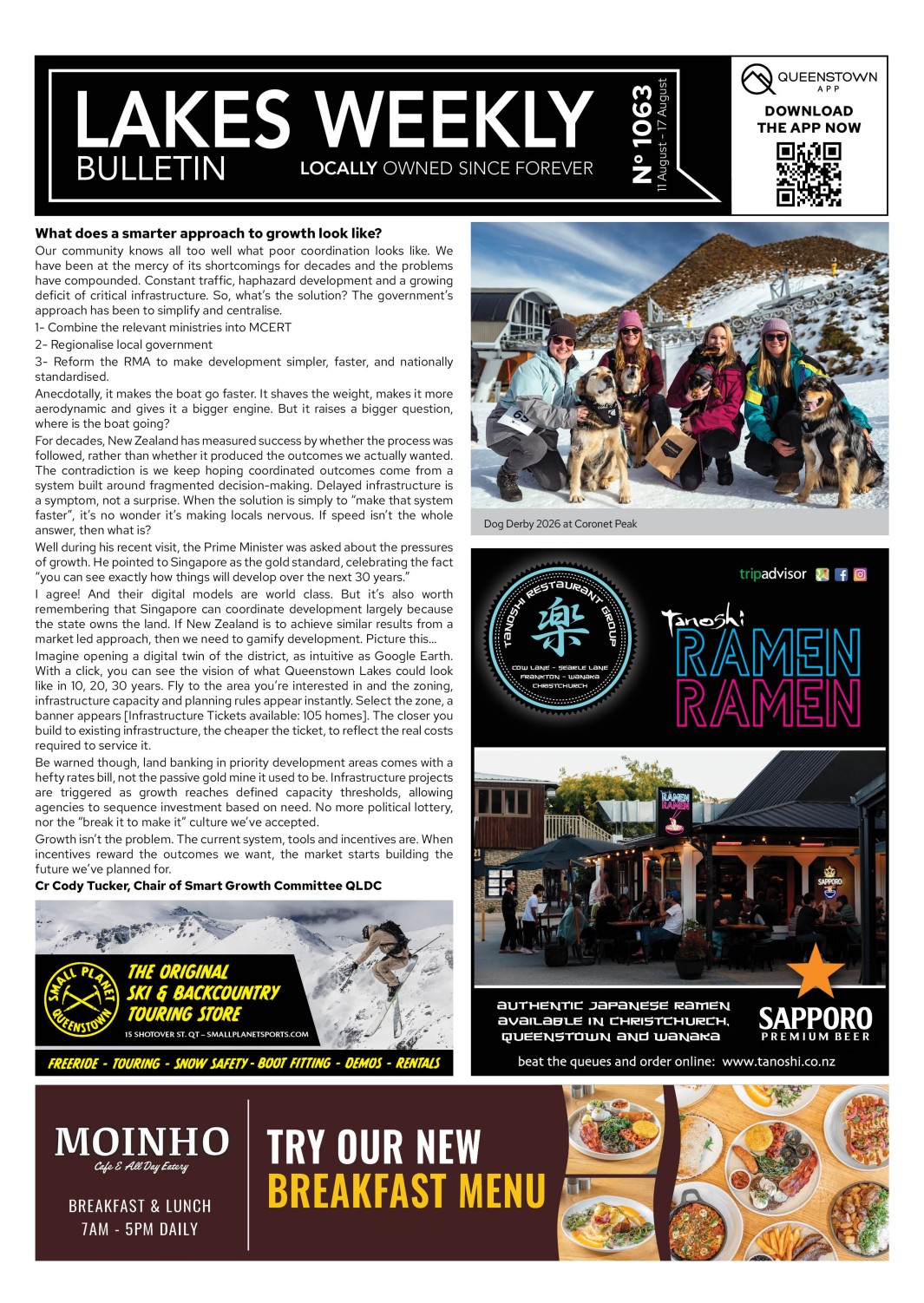
What does a smarter approach to growth look like?
by Cr Cody Tucker, Chair of Smart Growth Committee QLDC
Our community knows all too well what poor coordination looks like. We have been at the mercy of its shortcomings for decades and the problems have compounded. Constant traffic, haphazard development and a growing deficit of critical infrastructure. So, what’s the solution? The government’s approach has been to simplify and centralise.
1- Combine the relevant ministries into MCERT
2- Regionalise local government
3- Reform the RMA to make development simpler, faster, and nationally standardised.
Anecdotally, it makes the boat go faster. It shaves the weight, makes it more aerodynamic and gives it a bigger engine. But it raises a bigger question, where is the boat going?
For decades, New Zealand has measured success by whether the process was followed, rather than whether it produced the outcomes we actually wanted. The contradiction is we keep hoping coordinated outcomes come from a system built around fragmented decision-making. Delayed infrastructure is a symptom, not a surprise. When the solution is simply to “make that system faster”, it’s no wonder it’s making locals nervous. If speed isn’t the whole answer, then what is?
Well during his recent visit, the Prime Minister was asked about the pressures of growth. He pointed to Singapore as the gold standard, celebrating the fact “you can see exactly how things will develop over the next 30 years.”
I agree! And their digital models are world class. But it’s also worth remembering that Singapore can coordinate development largely because the state owns the land. If New Zealand is to achieve similar results from a market led approach, then we need to gamify development. Picture this…
Imagine opening a digital twin of the district, as intuitive as Google Earth. With a click, you can see the vision of what Queenstown Lakes could look like in 10, 20, 30 years. Fly to the area you’re interested in and the zoning, infrastructure capacity and planning rules appear instantly. Select the zone, a banner appears [Infrastructure Tickets available: 105 homes]. The closer you build to existing infrastructure, the cheaper the ticket, to reflect the real costs required to service it.
Be warned though, land banking in priority development areas comes with a hefty rates bill, not the passive gold mine it used to be. Infrastructure projects are triggered as growth reaches defined capacity thresholds, allowing agencies to sequence investment based on need. No more political lottery, nor the “break it to make it” culture we’ve accepted.
Growth isn’t the problem. The current system, tools and incentives are. When incentives reward the outcomes we want, the market starts building the future we’ve planned for.

WHY ADVERTISE YOUR BUSINESS WITH US
The Lakes Weekly is part of Queenstown Media Group (QMG).
QMG is Queenstown’s leading locally owned and operated media company with print, online and social platforms that engage locals with what they care about — everything local!
The Lakes Weekly delivers stories and news that connects with local so they come away each week better connected to their community. Advertising sits within this curated content environment, and it’s a trusted relationship between readers and the Lakes Weekly. Advertisers benefit from the association with the LWB brand values.
The Lakes Weekly is hand delivered to every business in Queenstown, Arrowtown, Frankton, Five Mile Remarkables Park and Glenda Drive on Tuesday. Copies are available in service stations, libraries and drop boxes throughout the region and every supermarket throughout the Queenstown basin and Wanaka.
Online the issue is available Monday afternoon, on lwb.co.nz and the Qtn App.
3,500
Printed copies
each week
13,250
Estimated weekly
readership
Latest issue