Zero carbon Queenstown tourism economy?
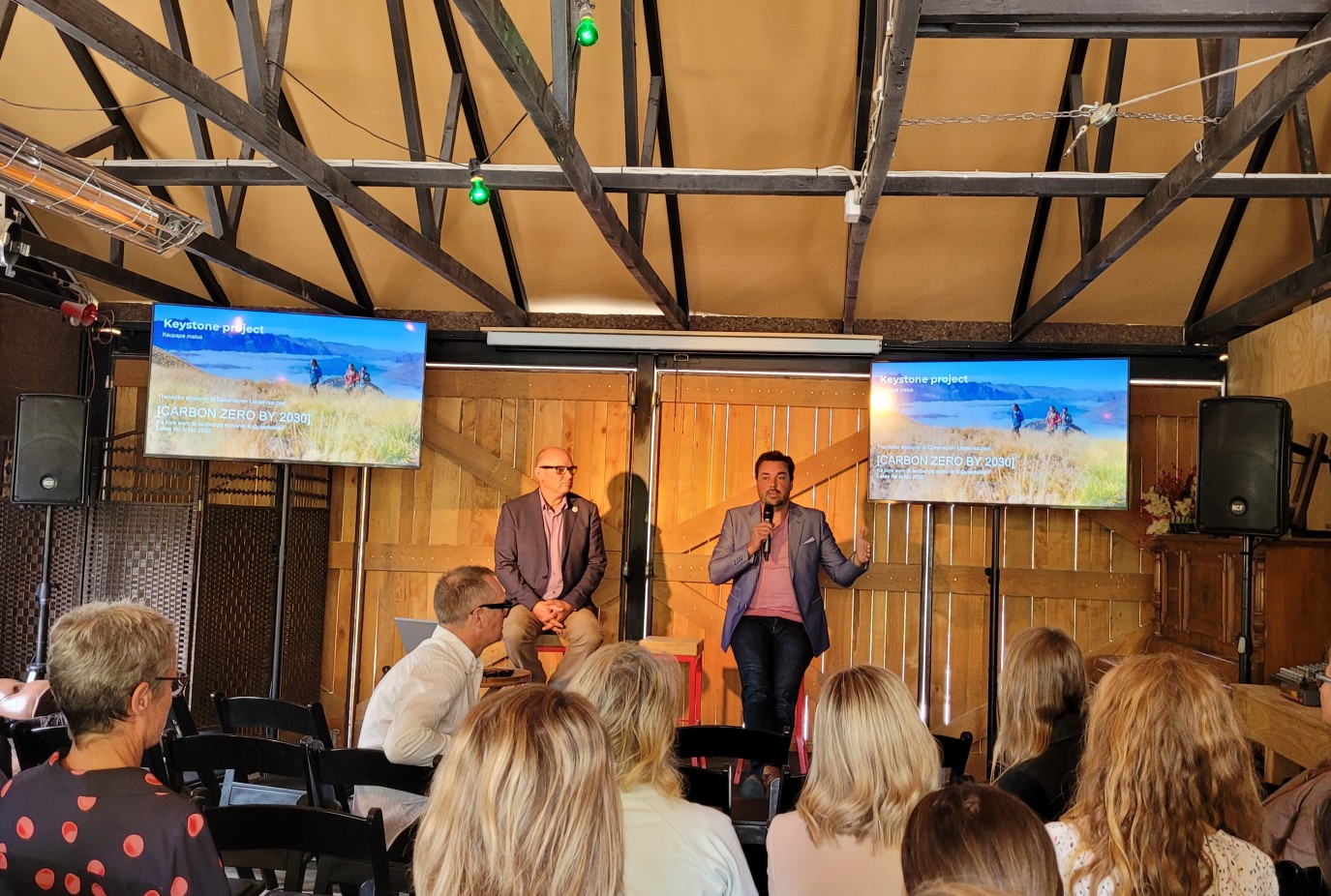
Queenstown’s tourism industry could set the radical goal of reaching ‘Carbon Zero by 2030’.That’s one of the proposals in the resort’s revised regenerative tourism strategy, which has been strengthened after feedback on the draft plan from the community and operators.
It’s the work of marketing organisations Destination Queenstown and Lake Wānaka Tourism, backed by Queenstown Lakes District Council.
DQ chief executive Mat Woods presented the plan to councillors, tourism operators and members of the public at a series of meetings last week.
There were audible gasps in the audience in Wednesday’s meeting when he unveiled the carbon-zero goal and slogan.
The next step is for the industry and community to debate whether it should actually become the focus of its efforts.
“We know this is ambitious but we think tourism can actually do good, and change and help this environment,” Woods said.
The plan could see Queenstown Lakes become a world leader in tourism decarbonisation, a ‘first customer’ for emerging technologies, such as carbon capture, electric helicopters and the like.
Tourism operators would also have to embrace change, taking individual responsibility for net zero by 2030, without off-setting.
Business owners, local politicians and industry leaders would be tasked with lobbying on a national level for the changes to legislation, energy infrastructure and funding required.
Rodney Payne, CEO of consultants Destination Think, which has worked on the plan, says the organisations realised it was difficult to get people excited about the goal of becoming ‘regenerative by 2030’.
“Because it’s hard to know what that really means,” he says.
“When we looked at all the projects, we were thinking is there one that we can elevate to start with, that everyone knows what it means... and we were pretty sure you can’t be regenerative without decarbonising.
“Focusing on decarbonisation first, it forces you to go to the root of the issue.” Payne says Queenstown could become known as the Silicon Valley of decarbonising tourism, adopting ground-breaking technology and clean energy solutions.
It could also look to manage the number of tourists, focusing on revenue, yield and margin, rather than bums on seats, and also change the visitor mix, appealing to tourists who don’t have to travel too far, as there are more emissions from those coming from farther away.
The net carbon-zero goal would include tackling ‘scope 3’ emissions, the emissions from tourists actually getting to Queenstown, he says.
That’s likely to be a sticking point, with Queenstown Airport Corporation forecasting passenger numbers (arrivals and departures) could grow to 3.2 million by 2032.
QAC chief executive Glen Sowry, at Wednesday’s meeting, said the council-controlled company is “very supportive” of the aspiration.
“The reality is that aviation, much as we would love it to be, will not be carbon zero by 2030, when you think of scope 3 emissions,” Sowry says.
“The positive thing is airlines and aircraft manufacturers the world over recognise this is an existential problem. If they don’t solve it, their ability to function and operate into the future is going to come under enormous threat and pressure.”
Sowry says there’s billions of dollars of investment going towards new technologies, such as hydrogen-powered and electric aircraft.
Electric aircraft, due to the physics, would likely only fly as far as Christchurch, whereas hydrogen could provide a short-haul alternative within the next 10- 15 years.
“Long haul, given the location we have at the bottom of the world, is a serious nut to crack,” Sowry says.
Sustainable aviation fuel is the likely the only viable solution in the short to medium term, he says. That can reduce GHG emissions by up to 80% over its lifecycle, compared to jet fuel.
Earlier this month, Air New Zealand announced it plans to begin replacing its turbo-prop planes (Q300s) with more sustainable aircraft – likely green hydrogen or battery hybrid systems – from 2030. Meanwhile, locally, RealNZ, has announced plans to make the TSS Earnslaw more sustainable, investigating alternative fuels for the coal-powered twin-screw steamer. The three possibilities are wood pellets, biofuel (gas / diesel) or hydrogen.
Only hydrogen would be zero-carbon, although all would produce fewer emissions than coal. The 110-year-old ship is one of the biggest single polluters in Queenstown, according to Otago Regional Council’s GHG Emission Inventory.
Queenstown Lakes District had one of the highest rates of gross emissions per capita in New Zealand pre-Covid, at 18.5 tonnes per resident of “carbon dioxide equivalent” (CO2e).
That’s due to the millions of tourists who descend on Queenstown and Wānaka each year, although the figure, from a council-commissioned Tonkin + Taylor 2018 study, does not include emissions from international flights.
Moving towards a regenerative model has been prompted by Central Government, who provided Strategic Assets Protection Programme (STAPP) funding to regional tourism organisations during the pandemic, to create new plans. It’s also an off-shoot of Queenstown Lakes’ Spatial Plan.
The first draft was released in July, after seven design forums, 50 one-on-one meetings and eight community workshops.
It has been viewed by 1800 people online, downloaded 600 times and received 33 pieces of detailed feedback from individuals and organisations.
Along with the headline grabbing zero carbon plan, the strategy has also been streamlined to three pillars to help Queenstown ‘travel to a thriving future’.
Pillar one is ‘enrich communities and enhance the visitor experience’; pillar two is ‘foster a visitor economy that restores the environment’; and pillar three is ‘build economic resilience, capability and productivity’. There are 21 projects across the three pillars.
The plan also has guiding principles: building communities, enabling regeneration, demonstrating leadership, working together and embracing change. And it sits with in a Kāi Tahu values framework.
The final strategy will be implemented as a partnership between Destination Queenstown (DQ), Lake Wānaka Tourism (LWT), Queenstown Lakes District Council (QLDC), Kāi Tahu and the Department of Conservation.